Two towhee day – is OK!

California Towhee

A common backyard bird for me, the California Towhee is a year round resident and a bird that has some interesting and unusual behavior.

Seeing two species of towhee in a day is not unusual in northern California, but it is unusual for my yard. In fact, today’s Spotted Towhee was the first I have ever seen here in 8 years at this house! Any day with a yard bird is a good one, but what excites me is seeing the pattern of yard bird arrivals and their relative abundance which is is pretty interesting and confusing at my location. I am a stone’s throw away from the ocean, in a small town surrounded by agriculture, chaparral, grassland and forest. Being on the California coast makes for great birding, but unusual birding. Believe it or not I have seen 15 species of warblers in my yard, most of them lost “vagrants” from the east of the continent. But even more unbelievable is that Spotted Towhee probably breeds within a mile of my place, but it took 8 years to see one! In that time eastern Tennessee Warblers have visited me on at least three occasions. This is all to do with how migratory the species are. Although only a mile from Spotted Towhee country, these birds here appear to be solidly resident and unlikely to move and wind up in unusual habitats like a back yard. Curiously Spotted Towhees are highly migratory in the eastern part of their range, but not here in California. They are also vocally different, and visually different too. I do not think this Spotted Towhee came from the more migratory eastern populations, but if some of you see something helpful in making this identification do let me know.

Spotted Towhee - male in my backyard. The first one ever for me here! Yard bird number 153.

Vagrants on the other hand have messed up “guidance systems” and they congregate along the coast, it seems that many do have some sense not to go off into the ocean thinking they are heading in the right direction. This is why the rarities show up more frequently here at my coastal location than residents, or even regular migrants. My 15 species of warbler do not include Hermit, MacGillvray’s or Black-throated Grey – three species that breed in and migrate through the county! There is little good productive habitat for migrant warblers along the coast, experienced birds and adult locals likely move inland through nicer Douglas Fir or live oak forest rather than here where it is more shrubby, or where we have patches of willow thickets and scrub. Bird banders have found that inexperienced birds tend to be the ones which use poorer quality coastal habitats, and this applies to east, west and Great Lakes coasts! Eventually I will get a Hermit Warbler here, it is a matter of time, but before that happens I bet another Blackpoll or Tennessee warbler or two will show up.

Back to the towhees. It was neat to see the two species side by side. Molecular work now confirms that these two birds are not closely related at all, they both are larger and long tailed sparrows but that is where similarities end. Something I had not noticed before was that the Spotted Towhee does a proper sparrow “hop” when it moves. The California Towhee on the other hand instead moves in a shuffling walk, not a noticeable gait like a Brewer’s Blackbird, but definitely not a hop. The very different shape was apparent as well with the California looking large bodied and small headed, while the Spotted had a relatively large and domed head. Pretty neat to watch these birds, neither of them rare, but enjoyable and a lot of questions came to mind. So if Spotted Towhee is possible, could the holy grail of backyard birds here be possible? The Wrentit? We shall see. Good birding, Alvaro.

Posted in Uncategorized | Tagged , , , , , | 1 Comment

Golden-crowned Sparrow or what?

hybrid sparrow?

A possible Golden-crowned x White-crowned hybrid perhaps?

The bird on the left is causing me to think, which is a good thing. There are a couple of things odd about it, I saw it today May 4, 2012 here in Northern California and it is pretty late for a Golden-crowned Sparrow overall. Although, when I do see late Goldens, they tend to be up in higher elevation sites, such as where this one was. But the real weird part is that it looks like a Golden-crowned except with a pale supercilium and dark eye line, features of the White-crowned Sparrow! This made me wonder if it is a Golden x White-crowned Sparrow hybrid, a rare but known hybrid. BTW – you can click on the photos to get a bigger version of the shot!

Hybrid Golden x White-crowned Sparrow - Half Moon Bay, CA. Misplaced the date.

In fact, that hybrid combination I have had twice in my backyard over the years. This is the only photo I have easily available of one of these birds. I was able to trap it and photograph this bird in the hand, the photo appears in Beadle and Rising’s photo guide to sparrows from a few years back. The hybrid is similar to today’s bird, but the striping pattern is much more well defined on the presumed hybrid. Also the bill is pinkish, like a White-crowned, and definitely unlike a Golden-crowned Sparrow.

Back to today’s bird. the bill is dark with a “horn” colored base to the lower mandible, pretty typical of Golden-crowned Sparrow. A close look at the primaries shows that they are pretty worn and frayed, suggesting that this is a younger bird (hatched in 2011). The weird bird was with a typical Golden-crowned and I could not see any size, structure or back color differences. It just had this funny head pattern. My impression is that this is a Golden-crowned, not a hybrid, but it is a particularly “retarded” bird in its head molt, or perhaps a bird that will not fully gain an adult type head pattern (likely a low hormone bird). The pale supercilium look is seen on winter Golden-crowns, although not as well marked as on this bird, and it may be a retained pattern common to Zonotrichia which few if any Golden-crowns ever get to show. It may be that you need a first spring immature, and one with low hormone levels during the head molt to get this? Well, that is my theory, and I have no idea if it is a good one or not. If the bill had been pink, or the back greyish-brown I would have gone for the hybrid theory.

Reminder – pelagic schedule is up for this summerfall.


Posted in News | Tagged , , , , | Leave a comment

Lawrence’s Goldfinch day

Male Lawrence's Goldfinch

Some birds in California are widespread, but there are the other birds that are special. We have two endemics, the Island Scrub-Jay and the Yellow-billed Magpie but there are many others that can be seen most easily in this state. One of those is Lawrence’s Goldfinches, or “Larry Finch.” But even here they are spotty and unpredictable. This year is turning out to be a boom year for them up here in northern California, where they are being reported at places much more coastal than is usual. Yesterday I had good fun seeing several pairs at a spot just east of San Jose, California where they usually are NOT present. It was a super diversion to see the goldfinches before giving my migrant land bird workshop. I also recorded their very tinkling and fast song, with a lot of mimicry. Both Lesser and Lawrence’s Goldfinches are superb imitators of other bird’s voices!

Larry Finch - Ed Levin County Park near Milpitas, CA

I am looking forward to more Lawrence’s Goldfinches as the season progresses. One over the house for the yard list would be great!

Alvaro


Posted in News | Tagged , , , | Leave a comment

THE SHEARWATERS ARE COMING, THE SHEARWATERS ARE COMING!

Hey there. As my pelagic fall season comes nearer (click here for schedule), I thought it would be fun to make a prediction. This is going to be a Manx Shearwater rich year in California. If by some miraculous reason I am correct, it is not magic, its just that I have a direct feed to what is going on right now in Chile. This has been a spectacular season (summer – fall down there) for Manx Shearwaters. Backing up a bit, Manx Shearwaters are birds of the Atlantic, they should not be on the Pacific, but they are being seen on the Left Coast with frequency for some years now. By this point they could be breeding up in Alaska or British Columbia, which would not be surprising as this species has been spreading in the Atlantic too.

     Manxie Valparaiso March 2012

A Manx Shearwater - one of 3, seen off Valparaiso, Chile on our Birds and Wine tour.

Manx Shearwaters are being seen practically on every pelagic out of Valparaiso in Central Chile right now. This started in February and is continuing to mid April! There was a spurt of sightings in 2008, but this is more than have ever been seen down there. Max Manx was of five in February, we saw three on our Birds and Wine tour (coming in 2013 again!), a poor photo of one of them is to the left. The expectation is that those birds off Chile right now will be moving north as we speak and they should show up in California in the spring and then again in the late summer and fall. It will be cool to see if they do come up here in numbers or not. There are not that many pelagics in Chile, so the fact they are being detected so regularly means there have to be a bunch of Manxies around. We shall see what we find this season – join me on a pelagic out of Half Moon Bay or Monterey to see what is out there!

"The Juan" a Juan Fernandez Petrel, endemic breeder to the islands of Chile. Our Birds and Wine trip is perfectly timed to see this ocean going beauty, and we drink the wine after not before the trip so you know!


Posted in Chile, News, Pelagic | Tagged , , , , , , , , | Leave a comment

Foxy Sparrows

This is an off the cuff post dealing with some Fox Sparrows I recently observed south of home in Half Moon Bay California. I should start by saying that Fox Sparrows are variable, and they are typically separated into four types which some consider are valid as separate species. The classic red one is the bird of the east and north, there is a dark “Sooty” along the Pacific Coast, an interior mountain form (Slate-colored), and a Oregon-California mountains (Thick-billed). Here on the Cal coast we tend to see only the Sooty. But even these vary, the darkest of the dark looks like this:

Sooty Fox Sparrow - Moss Beach, CA. One of the dark ones, probably a BC breeder?


Last week this bird was south of town, much paler than a Sooty and showing some reddish tones that were brighter than expected, and much grey on face and neck sides. This could be the crazy thing known as “altivagans” a form that is perhaps a hybrid (intergrade) zone between Red Fox Sparrows and Slate-colored Fox Sparrows.

Fox Sparrow, Cascade Ranch, California. Perhaps the confusing altivagans?


Then there was this bird last week, a whole lotta rust, slight wing bars and streaks on the back. This one is more clear-cut, it is the westernmost form of the Red Fox Sparrow, the subspecies zaboria. To eastern birders this bird will look too dull, but that is what zaboria can look like based on what I have seen up there in Alaska.

Fox Sparrow, Cascade Ranch. Red Fox Sparrow - zaboria.

Fox Sparrow, Cascade Ranch. Red Fox Sparrow - zaboria.


It is neat to see such a jumble of different forms down here in winter, it really puts us here in the Half Moon Bay area in direct connection with the habitats and ecology of Alaska, BC, and who knows maybe northern Alberta for the altivagans type thing.


Posted in News, Winter Bay Area | Tagged , , , | Leave a comment

Guatemala 2012 Slideshow

January’s Guatemala Tour was incredible! This was done as a private trip for the Idaho Bird Observatory, with co-guide Jay Carlisle. Here are but a few images of a trip that spanned the highlands, and had an extension to marvelous Tikal. E-mail me if you are interested in heading to Guatemala in 2013.

Posted in Guatemala, Uncategorized | Tagged , , , , | Leave a comment

Alvaro co-authors Sparrows-Buntings in HBW 16

I just returned from Guatemala to find the latest installment of the Handbook of the Birds of the World, volume 16. Although I have used this series for years, it was amazing this time around to have a chance to write for it! I co-authored the New World sparrows (Emberizidae) with my grad school prof, Jim Rising. I can’t quite say it was fun to do the work, it was grueling! But it is sure fun to see it out in print now – Wow! I hope you all like it.

Here is the link – handbook-birds-world-v16

Below is one of the species treated, the Blue Seedeater. It is a goo example of the taxonomic challenges brought about by publishing a book series on the birds of the world over several years. Things have changed over time! We included this in the Emberizidae as we had to stick to a taxonomy that was older and more stable, although now known to be a less than ideal way to sort out the 9 primaried songbirds. The seedeater is actually related to the Indigo Bunting and relatives, so a Cardinal, not an Emberizid. We were able to note this type of information in the text, but it is amazing how things changed – some seedeaters are tanagers, others are cardinals; some tanagers are cardinals and the bush-tanagers are Emberizids! It is difficult to follow, but exciting to know we are sorting out so much so quickly now.

Blue Seedeater

Blue Seedeater Male - Los Tarrales, Guatemala

Posted in News, Uncategorized | Leave a comment

Southern southerns and northern southerns?

The Southern Lapwing is a widespread species in South America. But it has a secret! It is possible that there is a southern Southern Lapwing, and a northern Southern Lapwing. Confusing, I know, but here is the run down: The four subspecies fit into two distinct groups. The northern and eastern “cayannensis” birds and the southern and western “chilensis” birds. The chilensis group is larger, stockier, longer-winged and shorter legged. They have greyer heads and necks, and the plume feathers are short and grey, you hardly see them. Often the leg colors are super duper bright pink.

Southern Lapwings from left to right: Chile, Mendoza, Argentina, Uruguay.

The cayannensis group on the other hand is slim, long-legged, short-winged and in coloration they are duller, not only in the leg and bill colors but also in the browner head and neck. In the northernmost populations the central dark mid-breast stripe is missing in cayannensis. The crest feather is obvious, long and black. What is really surprising once you know these birds, is the very different call types. The cayannensis have a two syllable “ter-O” which is repeated, one of the reasons it is known as the “tero” in Argentina and Uruguay. In Chile, the chilensis group has a harsh, rollicking and trilling voice that reminds one of a parakeet! More of a “Treeelooooo” which gives it the name “treile” in Chile. This would all be straight forward, except for the fact that in between the distribution of these two birds is a band of intermediates – hybrids! These are found in the foothills of the Argentine Andes, and presumably in northern Patagonia. I think there are two distinct species involved, with a limited amount of hybridization which may be recent as lapwing habitat has increased in this part of the world. In any case, it pays not to ignore lapwings, more is going on than meets the eye. I am aiming to publish my studies on these birds in time, which includes a summary of voice, and morphology. Too much to do, so little time ;-)

The photo at top shows chilensis, an intermediate (although on the chilensis side of the equation, except for that long black crest) and a cayannensis group (subspecies lampronotus) from Uruguay.

Posted in News, Uncategorized | Leave a comment

Island Girl seen in Chile!!

Having just returned from a great trip birding in Chile with Field Guides, in putting together the trip list one sighting stands out as a highlight. It is not a rare bird, an endemic, a regional specialty but instead one of the most widespread yet most amazing birds in the world. The Peregrine Falcon! But this is no ordinary Peregrine Falcon, it is “Island Girl.” Who is Island Girl? Well click on the Southern Cross Peregrine Site to find out all about her. This is a female Peregrine that has been satellite tracked for several seasons going back and forth from a central Chilean wintering site to breeding grounds in Arctic Canada’s Baffin Island! Have a look at her recent southbound migration here. Amazing isn’t she?

"Island Girl" at the Maipo River Mouth.

So understand our surprise when on November 11, 2011 we saw a Peregrine carrying a backpack and antenna zip through and scare up a huge flock of Franklin’s Gulls, South American Terns, Black Skimmers and various shorebirds and ducks at the mouth of Chile’s Maipo River Valley. She did not stoop on anything, but continued heading south. It turns out that we saw here on the very last day of her huge migration! The next day she was back at her traditional wintering site some miles farther south on the coast. What unbelievable luck to have crossed paths with a celebrity bird – WOW.

I am heading back to tour Chile in October of 2012 – contact me for more information. This will be the ultimate Chile birding tour!

Island Girl - a rather heavily marked tundrius Peregrine Falcon over central Chile!

Posted in Chile, News, Tours | Leave a comment

Pelagic birding – San Mateo Style

Buller's Shearwater looking "spiffy"

This was a fantastic, yet unusual pelagic trip. We had great looks at the birds out there, and there was a lot to see, but the abundances were all askew. The most common shearwater was Buller’s! In fact all of the Sooty and Pink-footed we saw did not add up to the number of Buller’s we found! Then in the jaeger department, the Long-tailed was by far the most common jaeger. The second runner up Pomarine did not even come close in numbers! This trip was actually a very good study trip to learn the Long-tailed Jaeger as there were so many around.

For amazing photos of our trip by Luis Villablanca – click here.

Listening in to the dolphins with the hydrophone! Photo Tom Goodier.

Similarly we had a lot of Arctic Terns,  more than one usually sees on a pelagic as well as a Common Tern (which was a county bird for many on board). Apart from the birds, we did have some nice Humpback Whales, pretty close ones in fact! Then there were several pods of Pacific White-sided Dolphins, the last with some Northern Right Whale Dolphins. Here one of our intrepid participants lowered a hydrophone into the water for us to hear what the dolphins were saying to each other. It was pretty cool, with clicking and squealing sounds that are difficult to believe are made under water! Wow. Also a highlight was seeing a huge Ocean Sunfish (Mola mola), these fish get big, very big. In fact a Mola mola holds the record for the heaviest bony fish ever caught – at over 5000 pounds.

Photo by Tom Goodier - us on the boat!

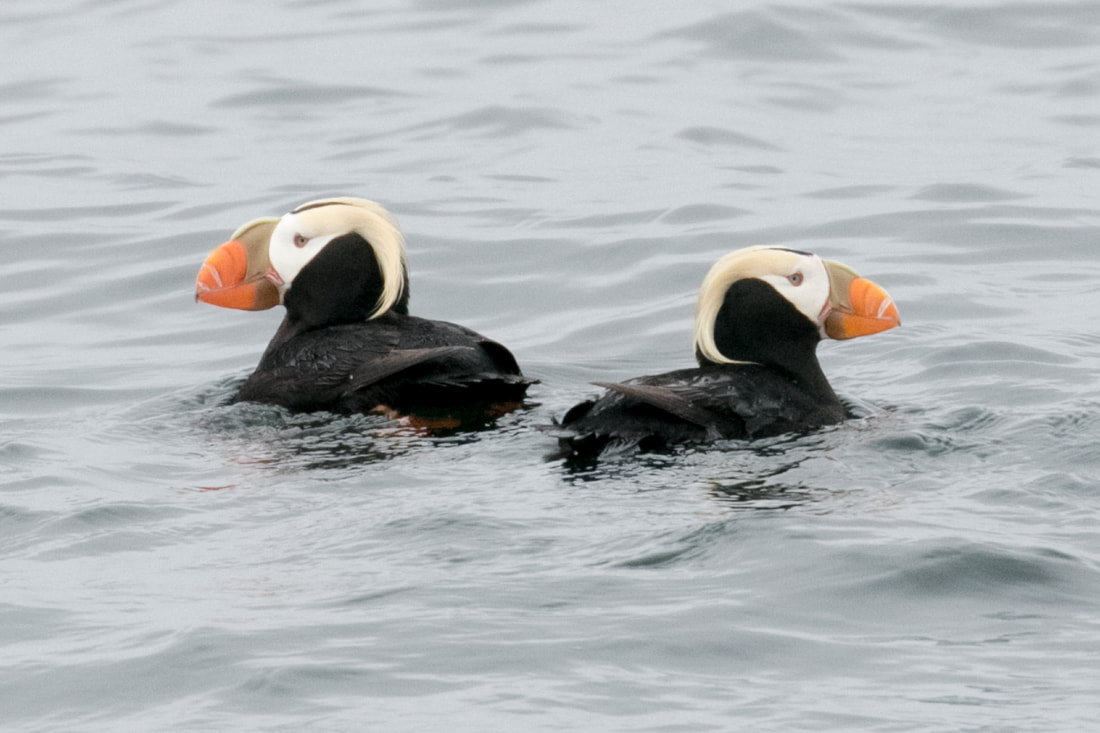
The trip was overall quite diverse. There were Ashy Storm Petrels around, although no concentrated flock of them. The cold water was here, but only a few people glimpsed a Fork-tailed Storm Petrel, suggesting that the mini invasion we had of that species is now over. Similarly, Northern Fulmar numbers were down from what was about a couple of weeks ago. We did have a fly by Tufted Puffin, wished it could have stuck around for a better view, lots of Common Murres, Rhinoceros Auklets, and a few Cassin’s Auklets and Pigeon Guillemot (latter close to shore). A South Polar Skua was nice enough to fly by, and there were many Red-necked and smaller number of Red phalaropes. Weirdo birds offshore included Northern Pintail, Northern Shoveler, Eared Grebe(!), Short-billed Dowitchers, and a single juvenile Sanderling looking a little lost.

Immature Long-tailed Jaeger - a confusing looking bird, which could easily be misidentified. Likely a two year old.

Adult Long-tailed Jaeger with full streamers - off Half Moon Bay, California.

A little jaeger talk now. On left is a good looking adult Long-tailed Jaeger, with a nice long tail streamer. The bird has a bill that looks short and stubby, also there is a nice  neat, cap, no breast band and a slight yellowish wash on the neck. The wings are narrow, and the rear end is dark, contrasting with a white breast. A telltale feature, particularly at this angle, is that the secondaries are primaries are clearly darker than the rest of the upper wings. The bird on the right is a messy one, a much more difficult identification. However it is a Long-tailed, but pale speckling on the underwings (click on photo to enlarge), means it is not an adult, and that messy plumage on the underparts is typical of winter adults and immatures. Yet the bill is short and stumpy looking, the neat cap is there, and the wings are relatively narrow.

Pomarine Jaeger - immature

Now for the Pomarine Jaeger study. This one on the left outwardly looks adult like, and it even has the spoon-tipped central tail feathers. But, look at the underwings, they are not entirely dark but are barred with white. This means it is not an adult but a younger age. This may be a second or third year Pomarine, likely a second year bird. The shape is important to look at, it is thick at the breast and the belly; it just look thick-necked and pot-bellied and much heavier than the Long-tails. The cap is not as neat as on a Long-tailed, and it reaches down to the chin and throat. Also the yellow of the neck sides is brighter on a Pomarine, and the thick and long bill often looks to have a pale base. Both Pomarine and Parasitic Jaegers tend to have a breast band as adults and in immature plumages.

Pomarine Jaeger adult

Now this Pomarine on the left is an adult (I have other photos showing entirely dark underwings). It also looks thick necked, and rather short-tailed; a good Pomarine feature. The short-tailed look is one reason that Pomarine may resemble a South Polar Skua, it is not just the larger size of this jaeger. The bill is big, long and thick and here you can see it is paler at the base with a dark tip. The cap extending below the bill to the chin and sides of throat can be seen, and the relatively strong yellow wash on the neck sides. The white shaft streaks on the primary feathers are extensive on Pomarine, while Long-tails often just show 2-3, and no white on the feathers themselves, as this bird shows. The white on the rump is the start of the winter plumage.

Sabine's Gull - what a year it has been for this species.

This trip was also one of experimentation. I tried a couple of chumming “concoctions” and found out that they worked! Yippee. I need to fiddle some more to get the concoctions just right, but they were fishy and stinky enough to bring in a Wilson’s Storm-Petrel out of nowhere! This is the first time I have seen this species in California away from a storm-petrel flock. It also was essentially a new San Mateo species for almost all on board, which meant big smiles to those playing the county birding game. Glad to have been of assistance folks!

Wilson's Storm Petrel - a rarity in San Mateo County. As we do more pelagics here we will surely find out it is regular, but we are still in the discovery phase!

Apart from having a good time, seeing birds, county birding and just enjoying the ocean, some of what we see also has scientific relevance. For example numbers and distribution of the birds that are out there. But more directly, we often see color marked birds, particularly Black-footed Albatross. When we can see the band number, such as on the bird below, the information is all sent to the Bird Banding Lab, where this will go into the database which helps in albatross conservation. Albatrosses are under high risk due to long line fishing mortality, although in Hawaii (where this albatross breeds) they have been very good at decreasing incidental deaths. All the more reason that these data are helpful to Hawaiian Seabird conservationists. Speaking of conservation, it was great to have Matthew Mckown aboard, a seabird biologist from UC Santa Cruz, who chatted with many folks about the work he is doing monitoring seabirds with remote sensors.

Looking forward to our next adventure at sea! Alvaro.

Band on Black-footed Albatross

Posted in News, Pelagic, Tours | Leave a comment